TaskRio vs Tasks.Bot for Voice to Task Automation Software
Assigning a task by voice note takes ten seconds. Getting that note into a tracker with an owner, a due date, and a status still takes a human retyping it. That gap is where field teams lose half their day.
This article compares TaskRio and Tasks.Bot on voice to task automation, covering how each turns spoken instructions into tracked work, how their language understanding holds up, and where Tasks.Bot's WhatsApp-native model fits. By the end, you will know which tool matches your team's workflow.
What Is Tasks.Bot? Voice-First Task Management on WhatsApp
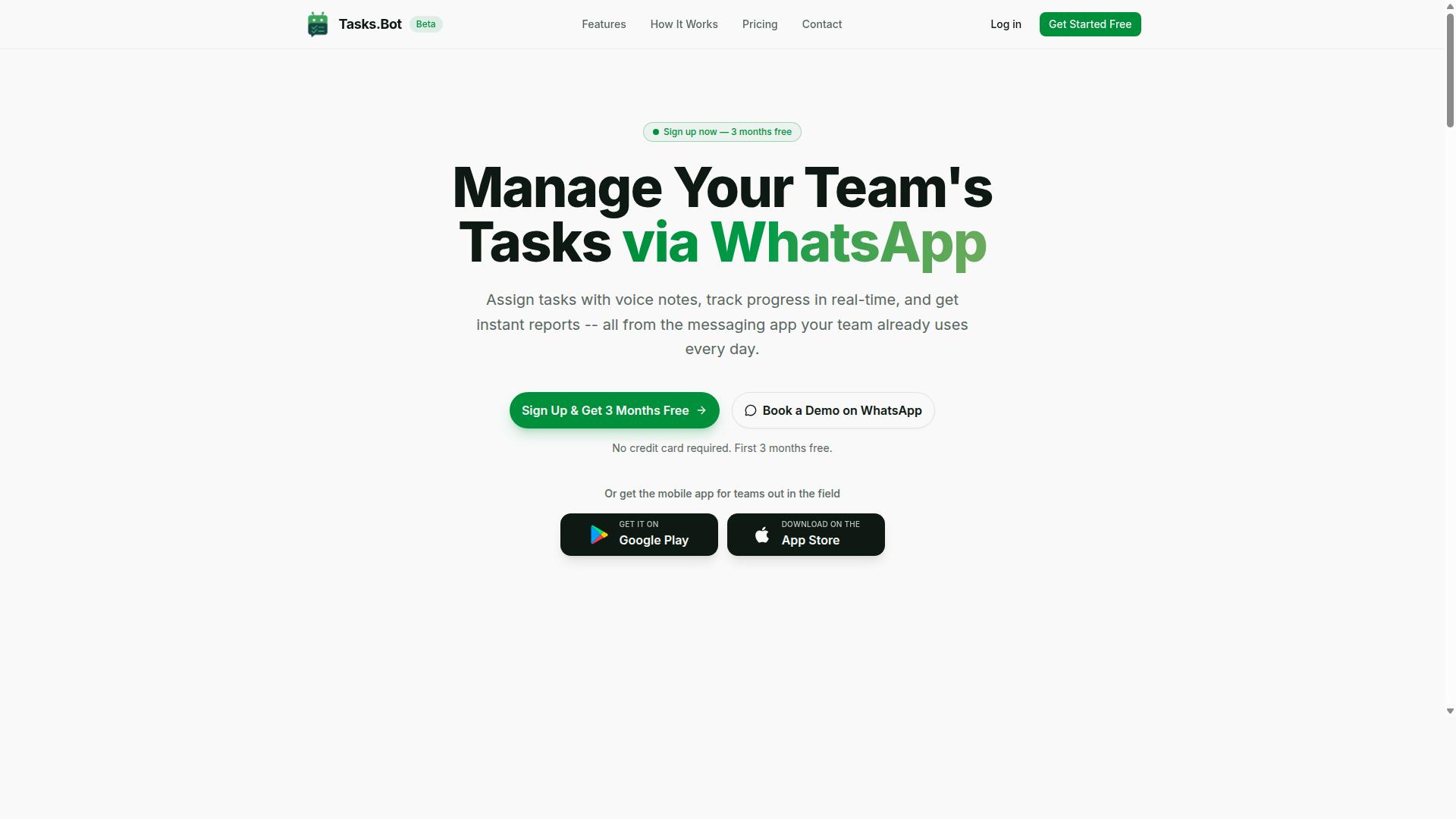
Tasks.Bot is a task management platform that operates entirely within WhatsApp, enabling teams to assign tasks, track progress, and receive reports without leaving the messaging app. Instead of asking people to adopt yet another productivity tool, it meets them in the app they already open dozens of times a day.
That design choice matters for adoption. Many task management rollouts stall because team members resist installing software or creating accounts. With Tasks.Bot, there is nothing to install and no new account to create, which removes the two most common friction points in team-wide adoption.
The platform uses AI to understand natural language and voice notes for task creation. A manager can speak a task the way they would say it out loud, and the system turns it into a structured, trackable item.
Tasks.Bot also offers a mobile app for field teams, extending its reach beyond the chat window. For organizations with staff on the move, that combination of WhatsApp-based coordination and a dedicated mobile app supports hands-free operation in real working conditions.
The service is currently in beta and offers a free trial period, so teams can evaluate whether WhatsApp-native task management fits their workflow before committing. Enterprise-grade encryption protects task data, and conversations and task data are never shared or used for training.
How Tasks.Bot Handles Voice to Task Automation
Tasks.Bot leverages AI to convert voice notes into structured tasks. The process follows a clear sequence from spoken words to an actionable item.
- A user records a voice note in WhatsApp, just as they would send any other message.
- Tasks.Bot transcribes the audio, turning speech into text.
- Natural language processing then applies intent recognition and entity extraction to identify what needs to be done, who should do it, and when.
- The system creates the task with those details attached, ready to track inside the chat.
The practical result is voice-to-task automation with no detours. Send a voice note saying "Assign John to fix the leak by Friday 5pm" and Tasks.Bot will create the task, assign it to John, and set the deadline. No typing, no form fields, no separate to-do list app.
Because everything happens inside WhatsApp, there is no new app installation and no account creation required. Team members simply send a voice note the way they already send messages, which keeps the learning curve close to zero.
This approach also supports natural language input alongside voice. Whether a task is dictated or typed conversationally, the platform's semantic parsing works to pull out the assignee, the action, and the timing. For teams juggling reminders, scheduling, and daily coordination, that means task creation becomes a natural part of the conversation rather than a separate administrative chore.
TaskRio vs Tasks.Bot: The Core Difference in Voice to Task Automation
While TaskRio offers voice-to-task automation, Tasks.Bot distinguishes itself by operating entirely within WhatsApp, eliminating the need for team members to install or learn a new app. That single design choice shapes everything else about how the two tools fit into a working day.
TaskRio generally follows the familiar productivity software pattern: a dedicated app or integration that users must adopt, log into, and keep open. Tasks.Bot takes the opposite route. It lives inside a messaging tool your team already has on their phones, so voice to task automation happens where conversations already happen.
The practical result is a much shorter path from spoken word to assigned task. There is no new account to create, no separate inbox to check, and no onboarding session before someone can capture a request. A team member simply sends a voice note, and the system takes it from there.
Under the hood, Tasks.Bot uses AI to understand user intent and create tasks from messages. That means natural language processing does the heavy lifting rather than rigid command syntax. You speak the way you normally speak, and the platform interprets what you meant.
This matters because voice commands only save time when they feel effortless. If a person has to remember exact phrasing or navigate a menu structure, the friction returns. Intent recognition and semantic parsing remove that barrier, letting a quick voice note stand in for a typed-out to-do list entry.
Tasks.Bot also goes beyond simple capture. Voice note task creation sits alongside automatic task assignment, smart deadline reminders, approvals and automations, instant reports, tasks on a map, a live day tracker, face-verified attendance, and shifts, leave, and hours management. For teams already coordinating through WhatsApp, that breadth means fewer tools to stitch together.
Accessibility is the other half of the story. Tasks.Bot is reachable through WhatsApp and through dedicated Android and iOS apps with push notifications, voice capture, and a home screen widget. A field worker can dictate a task from a phone, while a manager reviews it from the app. Hands-free operation stops being a novelty and becomes a normal part of the workflow.
So the core difference comes down to where automation lives. TaskRio asks users to come to it. Tasks.Bot comes to the place where your team is already talking, which is why it suits WhatsApp-based teams so naturally.
Voice Note Task Creation and AI Language Understanding Compared
Both TaskRio and Tasks.Bot support voice note task creation, but Tasks.Bot's AI goes further by parsing natural language to automatically assign tasks, set deadlines, and trigger workflows. Where many voice to task automation tools stop at converting speech to text, Tasks.Bot treats a spoken sentence as a complete instruction set.
That difference matters for anyone who wants hands-free operation rather than a faster way to type. Recording a voice note is easy. Getting software to understand what you actually meant is the hard part.
The Pipeline: Transcription, Intent, and Entities
Tasks.Bot uses AI to understand user intent and create tasks from messages. In practice this means a voice note moves through three stages before it becomes a usable to-do item.
- Transcription: speech recognition converts the recording into text, including the messy phrasing people use when speaking casually.
- Intent recognition: the system determines what the speaker wants, such as creating a task, setting a reminder, or requesting an update.
- Entity extraction: the AI pulls out the specific details, including the task name, the person responsible, and any deadline mentioned.
TaskRio, by comparison, is generally understood to handle voice capture at a more basic level, with the user doing more of the structuring afterward. Tasks.Bot's natural language processing aims to remove that cleanup step entirely.
The practical result is that no manual data entry is required. You speak, and the structured task exists.
Complex Commands Tasks.Bot Can Handle
Simple dictation tools struggle once a sentence contains more than one instruction. Tasks.Bot's semantic parsing is built for the way people actually talk, which often bundles several requests into one breath.
Consider a command like: "Remind Sarah to submit the report by Thursday and notify me when done." A basic voice-to-text tool would produce a paragraph of text and leave you to sort it out. Tasks.Bot's AI can identify the assignee, the task, the due date, and a follow-up trigger in a single pass.
Other examples of the same pattern include:
- "Ask Daniel to call the supplier tomorrow morning and flag it if he doesn't confirm."
- "Create a task for the design review next week and assign it to Priya."
- "Remind the warehouse team to check stock levels on Friday."
Each of these contains multiple entities, and each would normally require several taps in a traditional task management app. Voice commands collapse that into one action.
Why This Matters for Voice to Task Automation
Tasks.Bot's voice note task creation runs through its native WhatsApp integration, so the workflow lives where many teams already communicate. That removes the friction of switching to a separate productivity software window just to log a to-do.
The same understanding layer supports automatic task assignment, smart deadline reminders, approvals and automations, and instant reports. A spoken instruction can therefore feed directly into workflow automation rather than sitting in a notes app.
For teams weighing voice to task automation options, the deciding question is not whether a tool can transcribe speech. It is whether the tool can act on what was said. Tasks.Bot is built around that second capability, which is where the real time savings come from.
Key Features That Set Tasks.Bot Apart
Tasks.Bot offers a suite of features designed for teams that rely on WhatsApp, including field team tools, approvals, automations, and instant reports, all accessible within the chat. The core idea is simple: instead of asking staff to learn another dashboard, the platform meets them in the messaging app they already open dozens of times a day.
Two areas stand out. The first is field team tools, which cover GPS tracking, face-verified attendance, and a live day tracker. The second is workflow automation, which includes approvals, automations, and instant reports. Both groups of capabilities live inside WhatsApp rather than in separate software.
That design choice matters for voice to task automation. When someone sends a voice note, the AI understands the intent and turns it into a task, and the follow-up tools for tracking, approving, and reporting sit in the same thread. There is no handoff between a voice capture app and a project management system.
Tasks.Bot also provides Android and iOS apps with push notifications, voice capture, and a home screen widget, so teams that want a native mobile experience can still stay connected to the same workspace. The sections below break down the field tools and the workflow features in more detail.
Field Team Tools: GPS Tracking, Face-Verified Attendance, and Live Day Tracker
For teams with field staff, Tasks.Bot provides GPS tracking, face-verified attendance, and a live day tracker, all managed through WhatsApp to ensure accountability and real-time visibility. Each tool answers a different question a manager tends to ask during the workday.
- GPS tracking shows where field staff are, which supports tasks on a map and helps verify that a job site visit actually happened.
- Face-verified attendance confirms that the person checking in is who they claim to be, which reduces buddy punching and similar attendance gaps.
- Live day tracker follows task progress through the day, so supervisors can see what is done, what is in progress, and what is slipping.
The WhatsApp integration is what makes these tools practical for field work. A technician can check in from a phone without opening a separate app, and managers see updates as they arrive rather than at the end of a shift. The same chat thread that carries the check-in also carries the task itself.
These capabilities are part of the Full Access plan. A field service company is a useful example: technicians check in on arrival, the live day tracker shows which jobs are complete, and dispatchers can spot a delayed stop before the customer calls to ask about it. Shifts, leave, and hours management round out the picture for teams that schedule staff across locations.
Approvals, Automations, and Instant Reports Inside WhatsApp
Tasks.Bot streamlines workflows with approvals, automations, and instant reports, all executed within WhatsApp to reduce delays and keep teams aligned. The value here is speed: a request does not sit in an inbox waiting for someone to log into a separate tool.
Approvals work as a conversation. A team member requests sign-off in the chat, and a manager approves or rejects with a simple reply. Because the decision is recorded against the task, there is a clear trail without extra paperwork.
Automations handle the repetitive coordination work. Tasks can be assigned automatically based on triggers, reminders can be sent without anyone chasing them, and overdue items can be escalated. Smart deadline reminders and automatic task assignment are part of this same layer, which means fewer things fall through the cracks when a team is busy.
Instant reports close the loop. Reports on task status, attendance, and productivity can be generated and received directly in WhatsApp, so a manager can review the day without exporting a spreadsheet. This combination of approvals, automations, and reporting is what removes the need for a separate project management tool for many WhatsApp-first teams.
Voice fits naturally into this flow. A spoken update becomes a task, the task triggers the right automation, and the result shows up in a report. For teams weighing voice to task automation options, that end-to-end path inside one app is the practical difference worth noting.
Pricing and Plans: Tasks.Bot's Full Access Model
Tasks.Bot offers a single 'Full Access' plan that includes all features, with pricing available in Indian Rupees and US Dollars. There are no confusing tiers, no feature gates, and no upsells waiting at checkout. For buyers comparing voice to task automation software, that simplicity is worth noting: what you see is what you get.
The monthly plan costs ₹200 per member per month. The annual plan costs ₹1,200 per year per member, which works out to a saving of 50%, or ₹1,200 per year for each member on the plan. Teams that already know they will use the software long term get the better deal by paying yearly.
Because pricing is listed in both INR and USD, international teams can check costs in their own currency. The site includes a 'Select currency' option with Indian Rupee and US Dollar choices, so it is worth verifying the displayed currency before you commit. This matters for finance teams budgeting across regions.
New users also get 3 months free, with no credit card required, and the ability to cancel anytime. That trial window gives a field team or project group enough time to test voice note task creation in real working conditions before any payment is made.
Here is how the plan structure breaks down:
- Monthly: ₹200 per member per month
- Annual: ₹1,200 per year per member, a 50% saving
- Currency: Indian Rupees or US Dollars, selectable on the site
- Trial: 3 months free, no credit card required, cancel anytime
The Full Access plan covers the complete feature set: voice note task creation, field team tools, approvals, automations, and reports. Nothing sits behind a higher tier. For a manager weighing cost against capability, that means the per member price reflects the entire product, not a stripped-down version of it.
It is also worth knowing that the service is currently in beta. Early users are effectively getting full access at launch pricing while the product continues to develop. For teams comfortable adopting software early, that combination of a low per member cost and an open feature set is a reasonable position to take.
Compared with the usual pattern in productivity software, where voice features, automation, and reporting are often split across separate plans, a single all-inclusive price keeps budgeting straightforward. You multiply the per member rate by your team size and you have your number, whether you pay monthly or annually.
For a small team of five, for example, the annual route costs ₹6,000 per year in total, against ₹12,000 if paid monthly across the same period. The saving scales with every member you add, which matters for growing field or project teams.
The overall verdict on pricing is clear: Tasks.Bot keeps its cost model transparent and its feature access complete. One plan, two currencies, two billing cycles, and a free trial long enough to judge the fit. For voice to task automation, that is a straightforward and fair way to price software.
Trust Signals: Beta Status, Encryption, and Refund Policy
Tasks.Bot is currently in beta, which means the platform is actively evolving, but it already implements encryption and offers a refund policy to build user trust. For anyone weighing voice to task automation software, these signals matter as much as the feature list itself.
Beta status tells you something important about a product. It signals that the team is still shipping improvements, listening to feedback, and refining how speech recognition and natural language processing handle real-world commands. Early adopters get access before the wider market, and they often have a real voice in shaping what comes next.
That is the trade-off worth understanding. A beta platform may change quickly, and some rough edges are expected. In exchange, users who speak up about intent recognition accuracy, entity extraction quirks, or workflow automation gaps can influence the roadmap directly.
Encryption addresses the more serious question: what happens to the voice data and task details flowing through the system. Voice to task automation touches calendars, to-do lists, and project management entries, so protecting that information is not optional. Tasks.Bot states that encryption is in place, which is the baseline any productivity software handling dictation and transcription should meet.
The refund policy mentioned in the site footer adds another layer of reassurance. Subscribers are not locked into a commitment with no way out if the tool does not fit their workflow. That safety net lowers the risk of trying a platform that is still maturing.
One more detail stands out: the copyright year reads 2026. That forward-looking marker suggests a team planning beyond the current cycle rather than winding down. Combined with the beta status, encryption, and refund policy, the overall picture is a platform that is honest about where it is and serious about where it is going.
Who Should Choose Tasks.Bot for Voice to Task Automation
Tasks.Bot is ideal for teams that already use WhatsApp for communication, especially those with field staff who need task management, attendance tracking, and payroll-ready hours. The platform works inside a tool these teams already open dozens of times a day, so voice to task automation happens without asking anyone to learn a new system.
That matters most for crews who work with their hands. A construction supervisor on a ladder, a maintenance technician under a sink, or a delivery driver between stops cannot stop and type into a task management app. With Tasks.Bot, they speak a voice command in WhatsApp and the work becomes a tracked task.
The result is hands-free operation with no separate mobile app to install, no desktop app to configure, and no browser extension to add. Speech recognition and natural language processing run behind the scenes, so the team keeps using the same chat thread it already relies on.
Tasks.Bot reports that hundreds of teams already use the service for exactly this kind of work. That track record points to a simple pattern: the less behavior change a voice to task automation tool demands, the more likely a field team is to actually use it.
Industries that fit this profile well include:
- Construction: site leads dictating punch lists, safety fixes, and material requests from the floor.
- Maintenance and facilities: technicians logging repair jobs and follow-ups while still on site.
- Delivery and logistics: drivers flagging failed drop-offs, address issues, or returns in real time.
- Field sales: reps capturing visit notes, next steps, and reminders right after a client meeting.
- Cleaning and property services: crews recording completed units, supply needs, and shift hours.
Attendance tracking and payroll-ready hours give these teams a second reason to standardize on Tasks.Bot. A spoken check-in or task update doubles as a time record, which reduces end-of-week chasing for managers.
TaskRio, by contrast, is a standalone app approach. Teams that do not use WhatsApp, or that prefer a dedicated interface for dictation and transcription, may find that model a better fit. The deciding question is simple: if your team already lives in WhatsApp, Tasks.Bot removes friction that a separate app adds back.
Final Verdict: Is Tasks.Bot the Better Voice to Task Automation Choice?
For teams embedded in WhatsApp, Tasks.Bot offers a compelling voice-to-task automation solution that eliminates app fatigue and leverages familiar workflows. Instead of asking people to learn a new tool, it meets them where they already spend their working hours.
The core advantage is native WhatsApp integration. Voice notes, typed messages, and natural language requests all become structured tasks without leaving the chat. That single design decision removes one of the biggest barriers to adoption in task management software: getting the whole team to actually use it.
Tasks.Bot also brings advanced AI for voice and natural language into the picture. Speech recognition and natural language processing work together so spoken instructions turn into clean, actionable items rather than raw dictation. Semantic parsing, intent recognition, and entity extraction help the system understand what a person means, not just the words they used.
Field team tools round out the offering. For crews working on the move, hands-free operation matters, and voice commands make task creation possible when typing is impractical. This is where speech-to-task automation earns its place in a daily routine.
- WhatsApp-first design that fits existing communication habits
- AI-driven voice and natural language for accurate task creation
- Field team tools built for hands-free, on-the-go use
- Simple pricing with no complicated tiers to decode
TaskRio, by contrast, may suit teams that want a dedicated app with broader integrations. If your organization already lives inside Slack, Microsoft Teams, or a larger automation platform, a standalone tool with wider connector coverage can make sense. That is a legitimate preference, not a shortcoming of either product.
The deciding factor is usually team communication habits. If your people coordinate through WhatsApp all day, adding another app creates friction. If they work primarily in a project management suite, a dedicated app may slot in more naturally.
For WhatsApp-centric teams, the verdict is clear: Tasks.Bot is the stronger choice for voice to task automation. It combines familiar workflows, capable AI, field-ready tools, and straightforward pricing in one place.
To see how it fits your team, book a demo on WhatsApp. Reach the team at +91 97143 42522 or email [email protected].
Frequently Asked Questions
What is the main difference between Tasks.Bot and TaskRio for voice to task automation?
Tasks.Bot is built to run entirely inside WhatsApp, so your team can create tasks with voice notes and manage work without installing anything or creating new accounts. TaskRio is a separate voice-to-task tool, but since it works outside your existing messaging workflow, adoption often depends on getting your whole team to use another app. If your team already lives in WhatsApp, Tasks.Bot keeps everything in one place.
Do my team members need to download an app to use Tasks.Bot?
No. Tasks.Bot operates via WhatsApp, so team members can assign tasks, track progress, and receive reports right inside the messaging app they already use. A mobile app is also available for field teams that need it. This means there's no new account setup or training hurdle to get started.
How does voice to task automation actually work in Tasks.Bot?
Tasks.Bot uses AI to understand natural language and voice notes, so you can simply speak a task and it gets captured automatically. From there, tasks can be assigned, tracked, and reported on within WhatsApp, with features like smart deadline reminders, approvals, and automations. It's designed to feel as easy as sending a voice message to a colleague.
How much does Tasks.Bot cost compared to TaskRio?
Tasks.Bot offers a 'Full Access' plan with all features included, priced at ₹200 per member per month or ₹1,200 per year per member on the annual plan (a 50% saving), with pricing also available in US Dollars. We can't speak to TaskRio's current pricing, so we'd recommend checking their site directly for the latest numbers. What we can say is that Tasks.Bot's plan includes every feature with no tiers to compare.
Can Tasks.Bot handle field teams, attendance, and reporting?
Yes. Tasks.Bot is particularly suited to teams with field staff, offering face-verified attendance, tasks on a map, live day tracking, and payroll-ready hours. Instant reports are delivered right inside WhatsApp, so managers don't need to chase updates or log into a separate dashboard. It's built for teams that already coordinate over WhatsApp.
Is Tasks.Bot available in my country, and how do I try it?
Tasks.Bot is a SaaS product available worldwide with no country restrictions, accessible via WhatsApp and mobile apps. You can book a demo directly on WhatsApp to see how voice to task automation would work for your team. The service is currently in beta, and the site also mentions a refund policy for added peace of mind.
Recommended Resources: